NEILS 2011
Abstracts
(in
alphabetical order by surname of first author)
Sociolinguistic research on Tagin of Arunachal Pradesh
Binny Abraham
New Life Computer Institute,
Tagin is a tribal
community found mostly in the Daporijo area of Upper Subansiri district of
Arunachal Pradesh in
The language spoken by the Tagin community
is Tagin, which belongs to the
|
Year |
Population |
|
1981 |
27,122 |
|
1991 |
32,720 |
|
2001 |
38,244 |
1. Population
figures according to government census
In this paper my
attempt is to bring out some general conclusions about lexical similarity,
language use, attitude and vitality of Tagin varieties using the data I
collected from the region.
Lexical similarity study was
carried out using six wordlists (307 item word list) collected from different
locations among Tagin. This is a common method of measuring the relationship
among speech varieties to compare the degree of similarity in their
vocabularies. This process of evaluation was carried out according to standards
set forth in Blair (1990: 30–33) and facilitated through the use of a computer
program called WordSurv (Wimbish
1989).
|
(l) Baki/U.Subansiri |
|
83 (d) Taliha/U.Subansiri |
|
75 78
(n) Maskia/U.Subansiri |
|
77 74
70 (k) Nacho/U.Subansiri |
|
69 69
68 66 (j) Sippi/U.Subansiri |
|
67 65
72 64 59
(f) Takseng/U.Subansiri |
2. Lexical Similarity percentages Among Tagin
Although it is difficult to say that there is no dialectical variation
within the varieties, reported comprehension within each variety is not low as
portrayed here.
As analysis
of the questionnaire responses from the speakers proves that Tagin is used
widely almost in all important domains and the mother tongue speakers have a
very positive attitude towards it, the vitality of this variety may not be a
factor to be questioned. It would be hard to conclude that there is no
dialectical variation within Tagin. However, it appears that Tagins like to see
their language developed.
The variety
that could be considered as central for Tagin would be that spoken in and
around Nacho and
However, it
is hard to state about the dialectical variation within Tagin with the given
data, which would probably be more clarified through further investigation.
Gender in Aimol
Chongom Damrengthang
Aimol
Manipur University
Aimol is a
recognized tribe of Manipur. The total population of Aimol according to
census-2001 is 2,643. The Aimol tribe is found in Chandel, Churachandpur and
Senapati district of Manipur. The Aimols are mostly found in the plain or
valley of Manipur. The Aimol language belongs to the Old Kuki sub-group of
Kuki-Chin of the Tibeto-Burman language family (Grierson 1904: 245). It is an
agglutinative as well as tonal language. The word order of Aimol language is
subject-object-verb. Here the paper attempts to find out different types of
gender found in both animate and inanimate objects in Aimol. Details will be
discussed in the conference.
There
is no grammatical gender in Aimol. Human and animate nouns are referred to as
masculine or feminine on the basis of natural sex. For human beings, the suffix
̵̵̵̵̵̵̵̵pa indicates ‘male’ and ̵̵̵̵̵̵̵̵nu indicates ‘female’.
|
|
Male |
Female |
||
|
(a) |
kǝpa |
‘father’ |
kǝnu |
‘mother’ |
|
(b) |
puǝnrǝsukpa |
‘washer man’ |
puǝnrǝsuknu |
‘washerwoman’ |
There are other nouns which do not possess any generic name. Male
and female are distinguished by using words indicating opposite sex.
|
|
Male |
Female |
||
|
(a) |
ǝtǝrpa |
‘old man’ |
ǝtǝrnu |
‘old woman’ |
|
(b) |
pǝsǝl |
‘boy’ |
numǝj |
‘girl’ |
Male and female are also indicated by ̵kʰoŋ for ‘male (bird)’, ̵cǝl for ‘male (animal, insect or plant)’
but the female suffix ̵puj
is used for animal,
birds, insects and plants.
|
|
Animal |
Bird |
||||||
|
|
Male |
Female |
Male |
Female |
||||
|
(a) |
serat ̵̵̵cǝl |
‘bull’ |
serat ̵̵̵̵̵̵̵̵puj |
‘cow’ |
ar- kʰoŋ |
‘cock’ |
ar ̵̵̵̵̵̵̵̵puj |
‘hen’ |
|
(b) |
uj ̵̵̵̵̵̵̵̵cǝl |
‘dog’ |
uj ̵̵̵̵̵̵̵̵puj |
‘bitch’ |
|
|
|
|
Grammatical
Function Changing Rules in Assamese
Madhumita Barbora
This paper looks into two Grammatical Function (GF) rules namely
passives and causatives in Assamese, a language spoken in North East India.
Passives are best known of GF changing processes. Assamese allows both
periphrastic and morphological passive constructions along the lines of Keenan
and Dryer (2007). In periphrastic passive constructions, auxiliary verbs like ho ‘be’ and ja ‘go’ follow the main verb. The
auxiliary ho ‘be’ is the being or becoming type verb and ja
‘go’ is a motion type verb. In (1a) and (2a) we have the active sentences and
in (1b) and (2b) the passive counter part.
1a. ram-e kaam-tu kor-il-e.
Ram-agt work-cl do-pst-3p
‘Ram did the work.’
1b. kaam-tu kor-a hol.
work-cl do-nf be-pst
‘The work has been done.’
2a. moi ta-k iyar pora dekh-ũ.
I-nom him-acc here
posp see-1st p
‘I see him from here.’
2b. ta-k iyar pora dekh-a ja-i.
him-acc here posp see-nf go-3p
‘He can be seen from
here.’
The periphrastic passives in (1b) and (2b) show that the subject of the
active sentences (1a) and (2a) gets deleted. The main verbs of the passive
sentences kor ‘do’ and dekh ‘see’ take the non-finite marker -a and the auxiliary verbs take tense and
agreement markers. The objects NP tak
‘him’ in (2a) retains the accusative case marker -ak in (2b). The grammatical
subject in (2b) retains the accusative case marker if [+ animate]. Though
Assamese allows the subject → oblique phrase (or null), the second rules of
passivization namely object → subject need investigation.
Morphological passives do not
take an auxiliary verb; instead, the passive morpheme -i suffixes to the main verb as in (3):
3. iyar pora kamakhya dekh-i.
here posp kamakhya see-pass
‘Kamakhya is seen from
here.’
In (4), we have an instance of a causative construction.
4. moi tar-dwara / hotuwai kaam-tu kor-a-l-u.
I he-gen posp work-cl do-caus-pst-1st p
‘I got the work done by
him.’
Assamese causative markers have three forms -a, -uwa, and -owa. These three forms are mainly
phonological variants of the causative morpheme -uwa. Causative constructions
in Assamese do not conform to the hierarchical steps of Comrie (1976). The
causee, i.e., the lower subject does not surface with dative case but instead
with oblique case, thereby going lower in the hierarchy than predicted by
Comrie. In Assamese the hierarchical precedence does not work. The case system
seems more a case of “extended demotion” as per Comrie (1976). The two GF rules
can operate in one construction as in (6) below, where causitivazation precedes
passivization.
6. (mu-r dwara) ram-ar
hotuwai hari-k pit-uwa-ho-l.
me-gen posp ram-gen posp hari-acc beat-caus-be-pst
‘Hari was made to be
beaten by Ram (by me).’
From the Assamese data it is evident that the case system of the
language needs probing.
A preliminary sketch of Bugun phonology
Madhumita Barbora* and
Priyankoo Sarmah+
Khowa or Bugun is one of languages of the Kho-Bwa
group of languages. While the 2002 census conducted by the Indian government
puts the number of Bugun speakers at 1384, van Driem (2007) estimates that the
number of Bugun speakers is about 800 and it is a language on the verge of
extinction.
This study
aims at providing a basic sketch of Bugun phonology based on field recordings
done by the first author of the paper. Bugun speech data was collected from the
two Bugun speaking areas, Singchung and Wanghoo of
In terms of
consonants, this study also sheds some light into the complex onsets of Bugun.
Again, in case of onset consonants, the first author heard the [f] and [v]
alternatively produced as [ɸ] and [β], respectively. The current study uses
acoustic measures to see if this distinction exists phonetically. The first
author also reported hearing some of the Bugun stops alternating between being
voiced and voiceless. Hence, the stop consonants will be subjected to VOT
measurements to see if Bugun plosive consonants maintain the voicing
distinction consistently or not.
In this
study we would like to present a preliminary sketch of the Bugun phonology,
supported by acoustic analyses of Bugun speech sounds. This study hopes to
contribute towards the typology of Tibeto-Burman languages.
The Wihu-song of the Tangsa (Naga):
Poetry and linguistic forms, meaning and the transformation to a symbol
of identity
Meenaxi Barkataki-Rusheweyh* and Stephen
Morey+
The Tangsa
(Naga) people of NE India and
Within Tangsa, the various sub-tribes that
have migrated most recently into the plains of
In this paper, we will explore in more
detail, the Wihu-song, found in all of the Pangwa groups that we have
investigated. The Wihu song is sung in different cultural settings and can be
considered as a form of oral discourse serving different purposes. It can also
vary in its content and, in some versions, can be sung over several hours,
involving one or more singers. Essentially however, it is a song of praise to
the goddess or spirit of mother earth (Wihu) and can elaborate on pastoral
prosperity and well-being or narrate a kind of migration history of the Tangsa.
There are several styles of Tangsa songs,
of which Wihu is one. These styles can share the same content – the same set of
words being used in a sacrifice song, a spirit calling song or even a love
song. This suggests that each of these songs has a deeper meaning than that of
the words alone. The words sung are both content words and poetic forms used
for rhyming and metrical purposes. Moreover, the words found in the Wihu songs
are often in special song language, not used in everyday speech and not
understood by all. Some of these may represent forms that would have been found
in a proto-Tangsa speech, and are thus archaisms in use, perhaps, in some
communities but not in others. In the past Wihu song would have been understood
by all Pangwa, even when their everyday speech was not mutually intelligible.
Today there are not many Tangsa left who
can sing the Wihu song, even fewer who understand the archaic song language,
and moreover younger people often cannot understand Tangsa varieties other than
their own. The fact that the Tangsa languages are all oral has added to the
problem of documentation and transmission of this unique oral tradition. Using
actual examples, we would like to conjecture that soon the Wihu-song will be
transformed into just a symbol of cultural identity for the Tangsa, and will be
reinvented and retained in a much shorter form which will continue to be
ritually sung on festive occasions by the Tangsa in the years to come.
Relational Nouns in
Thadou
George Bedell
Thadou, also called Kuki or Thadou Kuki,
is a Kuki-Chin language primarily spoken in
In
example (1), the word nachunguva appears to
contain the prefix na-, which often
indicates agreement of a verb with its second person subject, and the suffix -u, which often indicates agreement of a
verb with its plural subject.
(1) mihon
nachunguva jouthua thugilou asei tengule
person-pl-by 2-about-pl-p various-p word-good-neg 3-say
time-pl-c
'when people say bad things about you' (Mt 5:11)
But nachunguva
'about you' is not an instance of subject-verb agreement, because chung is not a
verb but a noun. Its literal meaning is
something like 'top' and it often functions in Thadou like an English
preposition. Syntactically it
presupposes a genitive noun phrase; the latter is realized as na- and -u. The a which follows -u is a postposition, and the
intervening v represents a
phonological adjustment between the number agreement suffix and the
postposition. The analogous English
construction is something like 'on top of'.
Nouns like Thadou chung
or English 'top' are sometimes termed relational nouns.
Variations
in the structure are seen in (2) through (4):
(2) Aman
mipi chengse chu amun mol chunga
akaltouvin;
s/he-by people
many top 3-see-c
hill onto 3-go-perf-c
'seeing many people, he went onto a hill' (Mt 5: 1)
(3) naosen umna
chunga chun akingan ahi.
child be-nom over -p top 3-stop-c
3-be
'it stopped over where the child was' (Mt 2:10)
(4) Chunga leng vacha khu ngaitouvin,
top-p palace bird top
look-perf-c
'look at the birds of the sky' (Mt 6:26)
(2) shows an
overt genitive noun phrase: mol chunga
'onto a hill'; (3) a nominalized clause: [naosen
umna] chunga 'where the child was'; and (4) non-specification of any
genitive: chunga leng 'the palace
above' (i. e. 'the sky'). The paper will explore this Thadou construction in
comparison with other Kuki-Chin languages.
A preliminary study on Hakhun phonology
This
paper is a preliminary description of the phonology of one of the Tangsa
varieties, called Hakhun. Hakhun is a
sub-tribe of the larger Tangsa Naga community, which consists of several other
sub-tribes such as Cholim, Lochang, Youngkuk, Tikhak, Morang, etc. The Hakhun
call themselves as well as their language /haʔkʰun/. Within
This paper is based on data collected from
a small Hakhun village called Molu Goan, located at Ledo in the District of
Tinsukia,
Hakhun has a consonantal system consisting
of a series of stops contrasting three voicing types (voiceless, aspirated, and
voiced) at five places of articulation (bilabial, alveolar, palatal, velar, and
glottal). Besides the stops there are four nasals, four fricatives, two
liquids, and two glides. Hakhun contrasts seven vowels. Mean and standard
deviation of voice onset time are given for each stop type. F1, F2, and F3 are
provided for each of Hakhun vowels.
Pitch is contrastive in Hakhun. It
contrasts between a high, low, and a low falling pitch. Length is not
contrastive in Hakhun. However, high pitched words tend to be shorter than the
low pitched counterparts. Measurements of the pitch are given for each of the
pitch types.
The “sixth vowel” in the Boro-Garo languages
Robbins Burling
Most
languages of the Boro-Garo subgroup of Tibeto-Burman have relatively simple
vowel systems. Most, probably all, have the five
vowels that are common to many of the world’s languages: i, e, a, o, u. Most of
them have just one additional vowel, and it is considerably more variable than
the common five. The sixth vowel is never front, low, or rounded, but it varies
in position from high back to mid-central, and it is often shorter than the
other vowels. (B-G languages also have a few diphthongs, but these are ignored
here.)
Tiwa is the only B-G language that I know
to lack a sixth vowel. In Garo the sixth vowel is found only in closed
syllables, where it is high, back, unrounded and quite tense. It is in near
perfect complementary distribution with the high front unrounded [i] which
almost always occurs only in open syllables, although a tiny number of recent
borrowings have [i] in closed syllables. In the other B-G languages that have a
sixth vowel, it contrasts with all other vowels.
In Dimasa the sixth vowel is lower and
more central than it is in Garo, and also less tense. Oddly, it occurs only in
open syllables, the opposite of Garo, where it is found only in closed
syllables. The Dimasa version resembles the English schwa. It occurs most often
in weak word-initial syllables. The sixth vowels of other languages have more
variable properties than do the other five.
An attempt will be made to suggest a
scenario by which an earlier set of vowels could have evolved into the vowel
systems that we find in the present languages.
Manipuri colour terms: A study
Vindhyeshwari Chauhan and Javed Khatri
The M. S. University of Baroda
The present
paper is an attempt to study Manipuri colour terms. This paper has tried to
categorise the basic and derived colour terms in Manipuri language (Meitei
Long). It has been seen that the derived colour terms are highly culture
specific. This paper offers a cultural explanation of the derivation of colour
terms in the language. It tries to explain the inseparable relationship between
derived colour terms and the exquisite Manipuri culture.
Assamese Proverbs: An Ethnographic Interpretation
Mousumi Chetia and Shaikh Asma
The M. S. University of Baroda
The present paper is an
attempt to study the ethnography of Assamese proverbs. According to Hymes,
linguistic theory needs to be seen as a part of more general theory
incorporating communication and culture. Hymes’ theory of communicative
competence involves a definition of what a speaker needs to know in order to be
communicatively competent in a speech community. Proverbs are part of almost
all the languages of the world; so is the case with Assamese. There are many
proverbs that not only talk about cultural aspects of the community but are
also important from the perspective of culture formation. Various symbolisms, metaphors
and figures of speech are used in Assamese proverbs. In order for an individual
to be part of a particular speech community, Hymes proposes the notion of
Communicative Competence. Now, if we need to comprehend proverbs, what kind of
knowledge is required apart from the knowledge of the particular language?
There are proverbs which are related to many cultural artifacts, regional
terms, mythical characters and social norms; it would be necessary to
comprehend all these things in order to understand a proverb completely and
correctly.
The present paper is thus an inquiry into the Assamese speaker’s understanding of Assamese proverbs. The type of
competence required here is the basic notion of inquiry.
Preliminary phonology and morphology of Ralte (Mizoram)
Lalunthangi
Chhangte and R. L. Thanmawia
This paper is an introduction to the phonology and morphology of Ralte,
especially in comparison to Mizo. Ralte is an endangered language spoken in Mizoram.
There are no communities of speakers left and the remaining speakers are all
over 60 years of age. Even though Raltes live in Mizoram, the language is quite
distinct from Mizo. The paper will highlight the differences.
An
introduction to Nyishi grammar
Lalnunthangi Chhangte and Khoda Tana
This paper highlights some of the salient features of
Nyishi grammar and morphology. Even though several grammars of Nyishi
have been published, they were done by non-native speakers of Nyishi. The
second author of the paper is a native Nyishi speaker, and the data is provided
by him. The paper will present the morphological rules and some of the unique
features of the language such as generic-specific distinctions, demonstratives
and evidentiality.
Differential marking of cases in Asamiya
Runima Chowdhary
The aim of this study
is to investigate the factors underlying the assignment of various
morphological cases in Asamiya. The case system in the language not only
indicates grammatical relations, but also reflects semantic roles. While
nominative case for subject closely correlates with agent, nominals with
non-agentive properties may remain unmarked or be marked by non-nominative
cases, viz., dative, genitive and locative in the semantic roles of patient or
theme, recipient or benefactive, possessor or experiencer and location or
instrument respectively. The marking of accusative case for direct objects is
conditioned by an animacy hierarchy.
Focal marking of core arguments with three poly-functional
markers in War
Anne Daladier
Centre National de la
Recherche Scientifique
War
(Mon-Khmer) has three focal markings of core arguments. These markers are
constrained by the verb and they assign specific focal values to core arguments
according to their semantic values. The first two markers, ti ‘source’ and di
‘instrument’, assign contrastive focal values to subjects with these two
different agentive roles. The third marker haɁ marks a strong
beneficiary, often a kind of chosen value, for a beneficiary role of an
“animate” object. haɁ may also
focalize an inanimate object expressing that the subject took benefit of that
very object. With some verbs, haɁ and di may also involve an implicit
secondary action or an implicit request, with haɁ indicating a beneficiary and di indicating agentivity. The agentive markings apply both to
transitive and to intransitive verbs. The agentive and beneficiary markings may
appear alone or together in the same utterance.
The focal agentive marking interacts with an auxiliation
system, and produces complex values of agentivity (Daladier to appear). The
auxiliation system produces many kinds of active and passive values,
often associated with subjectivity values (e.g. volitional, happenstance,
empathy, adversative). This auxiliation system also conveys valency changes
such as intransitivizing and transitivizing on lexical elements. War has no
passive voice in the sense of a verbal marking with passive auxiliation, which intransitives
a transitive verb and conveys both a stative interpretation of this verb and an
affectedness interpretation of its argument. In War, intransitivizing and
transitivizing features of auxiliaries may foreground a subject argument with
diverse agentive roles, while in a language like English the passive voice only
foregrounds “affected” subjects. War has no kind of subject-verb agreement
and pronominal subjects as well as pronominal objects are usually omitted.
Focal markers are polyfunctional: (1) ti and di are also used as deictics (2) di, ti and haɁ are used as adjunct
markers (3) di, ti and haɁ are used as
focal markers of core arguments (4) haɁ and ti are used as assertive markers: haɁ may be used as a
declarative inferential marker and ti.ə
(ə is a plain declarative marker) encodes an empathic request to the
hearer to commit himself and in so doing to become the agent of the speaker's
intended purpose.
Though the grammatical uses of these
markers may seem very different, some kind of morphosyntactic and semantic
continuity appear to link them. War appears to have developed, and to still use
productively, a grammatical system with very little morphology and many
so-called discursive and pragmatic values expressed by grammaticalized markers
which are usually also lexically constrained. The focal marking of arguments
takes place within a system that I term “assertive”. I propose both an
interpretation of focal markers and of the polyfunctionality of these markers
in terms of this system of assertive marking.
Verb agreement suffixes in Mizo-Kuki-Chin
Scott DeLancey
Mizo-Kuki-Chin
is a low-level branch of Tibeto-Burman, consisting of two or three dozen
closely-related languages (the number will depend on what we choose to count as
distinct languages). The branch is defined as a genetic unit by several
phonological shifts and important morphosyntactic innovations, in particular
the grammaticalization of a morphophonemic alternation between two different
stems of the verb (VanBik 2006) and the innovation of a unique paradigm of
prefixal subject agreement on the verb. The MKC agreement paradigm is clearly a
shared innovation which characterizes the MKC branch and sets it off from the
rest of the family.
However, since the 1950’s we have known of
languages from the Northern Chin branch which also have an alternative set of
postverbal agreement forms (Henderson 1957, 1965; Stern 1963). These occur
either as independent words, as in exx. 1–2, or in
combination with a set of grammatical particles, as in 3–4 (exx. from
Tedim/Tiddim (
We find the same thing in the MKC
languages of Northeast India (mostly in Manipur, some also in
1SG 1PL 2SG 2PL 3SG 3PL
Tedim ìŋ ùŋ tɛʔ úʔ tɛʔ -- úʔ
Tarao iŋ / əŋ uŋ ce cew -- əy
Moyon iŋ uŋ cə co ə əe
Koireng iŋ uŋ si siŋ -- u
Sukte iŋ uŋ -- -- -- uʔ
Monsang ŋ nɯ sə/na sɯ/nɯ -- hɛ
Also in Daai, in the
Southern Chin branch, we find parts of this paradigm (So-Hartmann 2009:244-5),
1st person =ngü and plural
-u, but no evidence of a 2nd
person form. Again the postverbal agreement always occurs in a negated clause,
as in ex. 7.
Since these forms have cognates outside of
MKC, they must be older than the new prefixal agreement forms in the branch.
Examples
1) pài ìŋ (Tiddim)
go 1st
‘I go.’
2) pài tɛʔ (Tiddim)
go 2nd
‘you sg. go’
3) pài ní-ŋ (Tiddim)
go future-1st
‘I will go.’
4) pài ní tɛʔ (Tiddim)
go future 2nd
‘You will go.’
5) kipa dili se-no-tu (Tarao)
my.father
‘My father will
not go to
6) kəy sinema ən-no-tu-ŋ (Tarao)
I cinema go-neg-unrealized-1st
‘I will not see
the picture.’
7) am pye:n vaai xa=ngü (Daai)
neg speak go definitely-1st
‘I definitely
will not go and speak.’
Non nominative Subjects in Assamese Sadri
Lucky Dey
Assamese Sadri
(henceforth, AS) is the link language of the Adivasis or tea garden population
in
Besides the usual nominative subject case,
there are constructions in which we find non-nominative subjects. That is, the
subject NP receives dative, genitive, locative and instrumental case.
Dative case is usually assigned to the
goal or recipient in a ditransitive sentence. The dative case marker in this
language is -ke. Experiencer subjects
or the subjects of psyche verbs like ‘to feel’, ‘to like’ or ‘to perceive’ bear
dative case. Possessive and also some non-possessive NPs, in the subject
position, get the genitive case -r/-ker.
The subject NP, both animate and inanimate, takes the locative case marker -e or the locative post position me if it indicates location of the
argument in terms of space and time. In the case of animate NPs, it generally
refers to abstract locations. In AS, we also find instances of subject NPs
taking the instrumental case marker se.
The main argument of this paper is that,
like other Indo-Aryan languages, in AS, there is no one-to-one relation between
the case feature, that is, the syntactic coding, the grammatical functions, and
the thematic or grammatical roles. It depends purely on the verbal properties
of that particular language. The objective of this paper is to look into the
verbal properties of the constructions with various non-nominative subject
cases in the language under study.
In AS, we find that the occurrence of
dative and genitive subject case depends on volitional and non-volition verb
types. Predicates which require a dative subject can form a complex predicate
with light verbs like aa
‘come’ and de ‘give’. The N+V
conjunct here, mainly, indicates non-volitional action. Analysis of the AS data
in this paper shows that the verbs indicating voluntary actions have a
nominative subject case, whereas verbs indicating involuntary actions have a
dative subject case. The difference in the semantic roles of those arguments
with nominative and those with dative case can be in case of stative and
dynamic or non stative predicates. Moreover, the difference between nominative
subjects and genitive subjects can also be illustrated with the notion of volitional
actions and non-volitional actions. The use of light verbs or the auxiliary kar ‘do’ implies the former and the use
of verbs like ho ‘become; happen’
implies the latter.
Relational nouns in Assamese
Khirapada Dutta and Dipak Das
A Relational Noun is a
noun whose meaning involves a relationship between one noun and another; for
example, father, mother, brother, husband, etc. Languages like English have only a
few Relational Nouns, while Assamese, which is an Indo-Aryan language, has
significantly large variety of this type of noun. Assamese Relational Nouns
possess some unique morphological features, which are absent in other New
Indo-Aryan languages like Bengali, Oriya, Maithili, Magadhi, Bhojpuri etc.
Again, in Assamese, these nouns show agreement to person, which is rare in
other Indo-Aryan languages.
One remarkable feature of Assamese
Relational Noun is that it accepts double layered inflection. In Assamese, both
Case inflection and Personal inflection are used with Relational Nouns, and the
Case inflection always follows the Personal inflection. G. C. Goswami points
out, “the nouns with Personal inflection form the base, with or without the
Definitives following them, for the Case inflection” (Goswami, 1982: 270).
 N(oun)
P(ersonal) I(nflection)
[D(efinitives)] C(ase)
I(nflection)
N(oun)
P(ersonal) I(nflection)
[D(efinitives)] C(ase)
I(nflection)
In Assamese, without
the Personal inflection and the Case inflection, a Relational Noun cannot be
used in a sentence.
Though Assamese Relational Nouns are
unique for their special pattern of behaviour, no sufficient discussion is
found on this item of grammar. The study of Assamese Relational Nouns, which
may be an outcome of Non-Indo-Aryan influence, can throw new light onto the
formation and development of the Assamese language. In this paper, therefore,
an attempt has been made to study the Assamese Relational Nouns and their
characteristic features.
A
sociolinguistic survey on how bilingual is the Adivasi community in Assam
Luke Horo
PAJHRA
The objective of the survey was to
find the level of Bilingualism in Assamese among the Adivasis of Assam
primarily the children. Adivasis in Assam include 6 major language groups, Mundari,
Kharia, Sawra and Santali of Austro Asiatic and Kurux
and Gond of Dravidian language family. This survey has concentrated on 5
language groups excluding Gonds due to unavailability of sufficient
information on the group. Sadri of Indo Aryan stock functions as a
Lingua Franca among the Adivasis in Assam. This survey has also verified the
use of Sadri. For the survey people living in the villages and
Tea-Gardens in the Districts of Sonitpur, Lakhimpur, Kokrajhar, Udalguri,
Golaghat, and Dibrugarh were taken.
Goals:
1. Determine the level of Bilingualism among the Adivasis
in Assam.
2. Find the language use patterns of the Adivasis in
Assam.
|
No. |
Study |
Method |
Description |
Focus |
Sample
size from each location |
|
1. |
Children Bilingualism |
Assamese written text with questionnaire, informal interviews,
observations |
2 Assamese stories with questionnaire |
Proficiency level in Assamese |
10 children of 5-13 years old |
|
Adult Bilingualism |
Self-evaluation questionnaire translated in Sadri and five
Adivasi vernaculars |
15 questions |
Vitality of Adivasi languages & Adult proficiency level in
Assamese |
12 adults[1] |
|
|
2. |
Language use (education related) |
Questionnaire |
10 questions |
Language Use patterns related to education |
10 adults (teachers and parents) |
Methodology:
Findings:
The first test shows that Adivasi children in Assam have a low proficiency in Assamese. In the test out of 90
children only 20 managed to score the average in the first 5 questions but not
in the remaining 5. The rest of the children could not respond at all. Prior to
this a Home Town Testing was done for the Assamese text. For this 20 native
Assamese speaking children of same age and standard were taken. In this test 17
children scored high whereas 3 of them scored the average.
From
the second test it is concluded that Mundari, Kharia, Sawra,
Kurux and Santali are vital in limited areas and are spoken in
the domains of house, market and some workplaces. There are areas in Sonitpur
and Lakhimpur District where Sadri is spoken as the first language. The
level of Bilingualism in Assamese of the adult group is varied. The variation
depends on the following factors Location, Occupation, Literacy, Age and
Gender. Thus there are different levels of Bilingualism in Assamese of the
Adivasis based on the influencing factors.
The
third study showed that due to the low level of proficiency in Assamese the
Adivasi children have regularly dropped out. The concept of MTB-MLE was at the
same time appreciated by the parents as well as by the teachers. The results
from the survey indicate that language has been a major hindrance for the
children of the community towards education. Thus, it is recommended that an
effective MTB-MLE should be initiated for the community to make education
child-friendly.
The grammar of postpositions in Assamese
J. C. Kalita
Assamese, a member of
the Indo-European family and developed from highly inflectional Old Indo Aryan
sub-group, has turned into analytical nature with the formation of some post
positions and clitics in the language. The post positions are used as the
alternative to some case markers to show case relations (e.g. pɔra ‘from’ is
used as an alternative to ablative case marker and dwara ‘by’ is
used as an alternative to instrumental case marker) or to build other types of
functional relations between two words. These words in Assamese and other some
New Indo Aryan languages are similar to English prepositions in their
functional behaviour but different in position of use and governing their
complements mostly in genitive cases. These words have been derived from some
original nouns or adjectives some of which have completely changed the class
i.e. ceased to act as nouns or adjectives (e.g. pɔra‘from’)
although some others retain their original uses too (e.g. The term ħɔloni as a noun
means change, but as post position it means instead of). On the other hand some
of them are purely indeclinables (e.g. nisina ‘like’) but some are
partially declinables (e.g. lɔg-ɔt ‘with’, kaħ-ɔt/ kaħ-ɔloi ‘near’).
The purpose of this paper is to analyze the functional behaviour of this class
of words in Assamese in detail.
A comparison between Khasi and Thadou: a phonological
study
Barika Khriem and D. Mary Kim Haokip
Khasi, a Mon-Khmer
language of the Austrossiatic language family, is spoken in the East and
Jaintia Hills districts of Meghalaya. It is also found to be spoken in the
Cachar Hills district of Assam as well as in
The effect of borrowings on Tiwa phonology and numeral
morphology
U. V. Joseph
Don Bosco
Tiwa as spoken in the
hills around Umswai, 35 km south of Nellie, has a large number of lexical items
borrowed from the Indo-Aryan language Assamese. The majority of such words,
particularly older borrowings, have been naturalized into Tiwa in line with the
Tiwa phonological system. An analysis of such naturalized words reveals the
phonological mechanisms that have been operative. On the other hand, some of
the loan items tend to bend Tiwa’s native phonology, introducing sounds that
are new to Tiwa.
An area where there has been large-scale
borrowing is the numeral system. Tiwa, like other languages of the Garo-Boro
family, probably had full numeral and classifier systems of its own sometime in
the past. Under the influence of contact with Indo-Aryan languages like
Assamese, and probably Bengali, the native numeral system of Tiwa has been
nearly wiped out, leaving behind only the words for ‘one’ and ‘two’. Tiwa
speakers in Umswai use numeral and classifier systems that are a mix of the
native and the borrowed systems.
It appears that even this mixed strategy
is slowly giving way to a system which is completely of Assamese origin. The
introduction of non-native numerals has had the effect of altering the
morphology of the classifier construction.
This
paper proposes to analyse these two areas of Tiwa.
Karbi -lo
as a relationality marker of 'Reference to a Preconstructed Domain'
Linda Konnerth
Karbi, a Tibeto-Burman
language from
Specifically, the occurrence of -lo
can be subsumed under five situations:
1) Event sequences in
a narrative
2) A (temporal) change
of state
3) A (logical)
cause-and-result situation
4) Correcting a wrong
assumption
5) Progress so far
Examples (1) to (5) each show one instance
of every situation type in the corresponding order. Example (1) is the first
sentence of a personal narrative. All further predicates that provide the main
sequence of events of the story are equally marked with -lo.
Example (2) shows that the statement
'there is no meat' without -lo as in (a) is a general statement which
could be said in the context of a market seller who never sells meat, or a meal
that is vegetarian. The statement with -lo in (b), however, involves a
change of state, which could be translated by English 'anymore', and would
apply in the context of a seller who has sold all the meat, or a meal that
included meat, but all the meat is eaten up.
In example (3), the second statement 'the
road was very dusty' actually results from the first statement 'the road was
very bad', since bad roads have many potholes, and a lot of dust accumulates in
them. Therefore, the second statement is a result of the first statement, and
is marked with -lo.
In (4), the negatively asked question in
(a) is positively answered in (b). The emphatic sense of affirming a
proposition against the presupposition underlying the question is conveyed by -lo.
Finally, the use of -lo in (5) can
be explained as the situation type 'progress so far', where -lo occurs
on verbs that do not indicate a change of state, but instead mark a gradual
change consistent with the prior state.
The function of -lo as exemplified
by these five types of usage is one that signals a temporal relationship (as in
the change of state and the progress so far type), a logical relationship (as
in the cause-and-result type), an information structure relationship (as in the
'correcting a wrong assumption' situation), or the relationship of events
within a narrative (as it occurs on event sequences). This function of relating
a statement to another statement, cultural knowledge, or past or future event
appears to motivate the instances where -lo is used, and I will use the
term 'Reference to a Preconstructed Domain' to refer to this concept.
(1) a-dap prang ne-tum thur-lo
attr-morning dawn 1:excl-pl get.up-lo
'we got up early in the morning' SH, CS: 001
(2) (a) ok ave (b) ok ave-lo
meat not.be.at meat not.be.at-lo
'there
is no meat' 'there is no
meat left/anymore'
(3) tovar heno-pik anke tovar longle a-duk=ta do-pik-lo
road be.bad-very and.then road earth attr-dust=also
be.at-very-lo
'the road was very bad, and so the road was very dusty' SH,
CS: 031-032
(4) (a) {nopak=ke pon-pe ma?}
knife=top take.away-neg q
(b) nopak=ta do-lo
dak lahe
knife=also be.at-lo here that.way
'{(he)
wasn't carrying a knife?}... '(he) did have a knife
also there.' HK, TR 027-028
(5) lapen aphi=ke bang+so a-jangreso the-lo
and.then after=top this attr-single.parent.child be.big-lo
'and then, that single parent child grew older/became an
adult' (Grüßner 1978:156)
A comparative study of ‘taste’ words in Assamese and
Korean
Hae-Yun Lee and Priyankoo Sarmah
Hankuk University of Foreign Studies
In this paper, using
an ontological method of linguistic typology, we investigate the words related
to ‘taste’ in two languages: Korean and Assamese. Considerable progress has
already been made in categorizing taste terms in various languages, based on the
words’ senses. Word nets created for English, German, Japanese and Korean can
show the ‘taste’ terms and their categorization (Figure 1). Even though
languages broadly employ these ‘taste’ categories, suggesting a psychological
saliency of ‘taste’ concepts, their conceptualization remains dependent on the
language and the culture (Hirst 2004).
Figure
1: Basic taste categories in various languages

In the case of
Assamese, our background literature search did not provide us with any
categorization of the Assamese ‘taste’ terms.
Hence, we decided to test the feasibility of the ‘taste’ terms
categorization used for Korean in a top-down ontological method (Lee and Kim,
2010). In the method described by Lee and Kim (2010), five basic concepts are
proposed as basic concepts for taste: sweet,
sour, bitter, salty and savory.
They argue that it is possible to classify taste related terms using these five
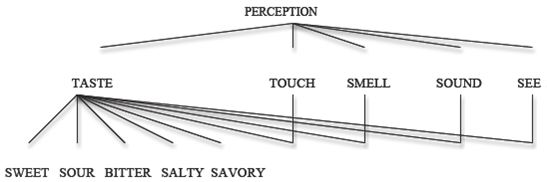
proposed concepts of taste in combination with other ‘sense’ concepts. Hence,
Lee and Kim (2010)’s proposed taste ontology can be conceptualized as in Figure
2.
Figure
2: Taste Ontology (Lee and Kim 2010)
Collecting taste words
from online and offline Assamese dictionaries, we investigate if the Assamese
taste terms can be categorized in the manner described in Lee and Kim (2010).
Secondly, we also try to determine the distribution of taste words according to
the five basic concepts proposed. As the ‘taste’ or ‘perception’ words have
never been analyzed in Assamese, particularly with the ontological method, we
hope to provide a new perspective on analyzing ‘sense’ in Assamese with the
current study.
Some phonological features of Dimasa and Tedim Chin
Monali Longmailai and Zam Ngaih Cing
North Eastern
Dimasa is a Bodo-Garo
language spoken in
In this paper, besides the above mentioned
phonological features, we will discuss tone sandhi, deletion, insertion,
gemination, and alternation. Finally, we will discuss the phonological
typologies of Dimasa and Tedim Chin and trace out further problems in relation
to these two languages.
The
Milang pronominal paradigm: A new type of clusivity?
Yankee Modi and Mark W. Post
Milang is a language provisionally aligned with,
though ultimately somewhat distinct from, the Tani group of Tibeto-Burman
languages (Post and Modi under review). Unlike the Tani languages documented to
date, all of which appear to lack any sort of clusivity distinction in their
pronominal paradigms, Milang exhibits an alternation in the plural pronoun set
which seems to count as a variety of clusivity. However, unlike the
cross-linguistically well-attested inclusive/exclusive
distinction (Filimonova, Ed. 2005), which is generally exhibited among first
person plural pronouns only, Milang exhibits a clusivity alternation among
first and third person plurals. The goal of this paper will be to explain the
functional basis for this distinction, with particular attention to the use of
plural pronouns in Milang discourse.
Typological survey of reciprocal constructions:
A case study of Meitei, Nyishi, Assamese and Bangla
Bipasha Patgiri and Atanu Saha
Across languages, strategies for making reciprocals are
distinguished in terms of two major types: lexical and syntactic. Syntactic
reciprocal constructions are formed by using a reciprocal pronoun; according to
Heim, Lasnik and May (1991), these reciprocal pronouns are composed of a
distributor and a reciprocator. This is clearly the case in Eastern Indo Aryan
languages like Bangla and Assamese:
1) ɾam aɾu hɔɾi-ɛ izɔn-e xizɔn-ɔk maɾilɛ.
Ram and Hari-erg self-erg self-acc hit.Pres
Perf.3P
‘Ram
and Hari hit each other.’ (Assamese)
2) ram o/eboŋ/ar hori ɛke anno-ke merechilo.
Ram
and Hari one another-acc hit-pst
perf.3P
‘Ram
and Hari hit each other.’ (Bangla)
The other strategy of creating a reciprocal situation is by marking the
verb with either a verbal template as in Hebrew, a verbal suffix as in Russian,
or using a clitic etc., as in Chichewa. The strategy is cross linguistically
decided by looking at the class of the verb. Verbs can be classified into three
types in terms of reciprocity: (i) inherently reciprocal, like meet, quarrel, etc. (ii) not inherently
reciprocal but able to be used as reciprocals, like love, kiss, etc. (iii) in some languages (Maslova 2008), verbs like
sing can be reciprocated.
Reciprocal constructions in two
Tibeto-Burman languages (Meitei and Nyishi) look like the following:
[Main verb/root-reciprocal affix-aspect
marker] or
[Main verb/root-collective
affix-reciprocal affix-aspect marker]
However, these languages also allow a
syntactic reciprocal to denote reciprocity.
(3) ɟɔn lo meri at̪am at̪e aɲa-minsu-do.
John and Merry each other love-rcp-asp
‘John and Merry love each other.’ (Nyishi)
(4) jɔn-gə meri-ge nuŋsi-nə-i.
John-agt Mary-agt love-rcp-asp
‘John
and Mary love each other.’ (Meitei)
(5) ram-gə meri-gə-nə amana amabu ŋəi-ri.
Ram-agt Mary-agt-nom one other wait-asp
‘Ram and
Merry waited for each other.’ (Meitei)
The motivation of this
paper is that all the four languages are spoken around the same region and yet
they differ in terms of reciprocal strategy from each other. It is observed
that Assamese and Bangla prefer a unified lexical strategy. Nyishi, a TB
language, can allow the syntactic and the verbal reciprocal together in a
construction. Manipuri has a clear choice in terms of choosing the reciprocity
either by syntactic means or by putting the reciprocal suffix in the verb. It
can thus be said that the TB languages are richer in terms of expressing
reciprocity than their Indo-Aryan counterparts. This paper is an attempt to
make a comparative study of these languages and their argument structures and
relevant theoretical questions will be discussed.
Variations in
the pagro and mo:jiŋ dialects of Mising
Jugendra Pegu
This paper is an attempt to investigate the variations that exist
between the pagro (PM, hereafter) and
mo:jiŋ (MM,
hereafter) dialects of Mising, a language which belongs to the
Dibrugarh, Sivasagar, and Golaghat (also in
and padam), which is spoken in Arunachal
Pradesh. The mo:jiŋ
data presented in this paper, for comparison, would be from the variety spoken
in
We notice phonological
variations between PM and MM dialects at different levels. The retention and
the loss of syllable codas (the lateral l
and the velar nasal ŋ) vary in the
dialects considered for the study; the syllable coda l is preserved in MM but not in PM or any other Mising dialects,
and the coda ŋ is prone to loss in MM
while we find its retention in PM and other Mising dialects. We also observe
variations in geminate/non-geminate consonant clusters and question words. The
study also expounds the substitutability of various consonants (for instance,
the lateral l ~ the tap r as in lukkum ‘red ant’ ~ rukkum ‘red ant’) and vowels (for
instance, the central high vowel ɨ ~
the central mid-vowel ǝ as in ɨmɨ ‘fire’
~ ǝmǝ ‘fire’) in the same environment of different lexical classes (nouns,
verbs, and adjectives).
At the morphological level
this paper focuses on the variations observed in the processes of
word-formation (for instance, prefixation) and various grammatical suffixes.
This paper also sheds light on the variations observed in different lexical
categories and varied functional words that occur due to different geographical
settings and/or its closeness to some adi
dialects (miɲoŋ and padam) as spoken in the
abutting areas of Arunachal Pradesh. Striking variations at the morphophonemic
and morpho-syntactic levels are also noticed to a great extent. Thus, the paper
is a study on the dialectal variations between PM and MM at the (1)
phonological (2) morphological and (3) morphophonemic/morphosyntactic levels.
Siangic: A new language phylum in North East India
Mark W. Post* and Roger Blench+
The Cairns Institute,
It has long
been noted that Arunachali languages are somewhat unusual in the Tibeto-Burman
context, even by North East Indian standards. In fact, although
little-described Arunachali languages like Sherdukpen, Sulung, Bugun, Aka,
Miji, Koro and Milang are widely assumed to be Tibeto-Burman – and certainly do
exhibit at least some characteristically Tibeto-Burman roots – there has
neither been a convincingly systematic demonstration of their genetic position
within Tibeto-Burman, nor indeed has there been a clear demonstration that such
Tibeto-Burman roots as they do exhibit are the result of genetic inheritance
rather than contact. In some cases (such as Aka), the number of seemingly
non-Tibeto-Burman roots is so great that the case for acquisition through
contact seems at least as plausible as that of inheritance through contact
(Blench and Post in press).
Whether or not we ultimately consider
Arunachali languages to have a primarily Tibeto-Burman genetic core, the fact
remains that we have a huge number of seemingly non-Tibeto-Burman roots to
account for in all of these languages – usually, the statistical majority. There
are only two plausible explanations here: either these are genetically
Tibeto-Burman languages which have acquired massive non-Tibeto-Burman
substrates (presumably from pre-existing isolate populations), or we have been
wrong to classify these languages as Tibeto-Burman, as they are in fact
language isolates which have simply been in contact with Tibeto-Burman
languages at various points in their history.
With this backdrop in mind, the present
paper will demonstrate two things: first, that Koro and Milang constitute a
genetic unit at some deep but nevertheless partially-reconstructible period;
second, that forms which reconstruct to this level are of mixed Tibeto-Burman
and non-Tibeto-Burman cognacy. The ultimate assignment of the genetic unit
formed by Koro and Milang to Tibeto-Burman or to some phylum outside
Tibeto-Burman is something that probably cannot be determined until more
high-quality Koro data becomes available. But in a sense, the implications for
pre-historical reconstruction are identical: there must have been at least one
non-Tibeto-Burman language phylum in Central Arunachal Pradesh prior to the
spread of Tani speakers throughout the area now separating the Koro and Milang
language areas, and this phylum is now reflected either as a substrate in
Proto-Koro-Milang or else as the primary genetic component of Koro and Milang
themselves. We refer to this phylum using the provisional label Siangic.
A
study of quotative verb constructions in Manipuri
N. Pramodini
Manipur University
The research reported here is an attempt to explore the multiple
functions of haybǝ ‘say’ in Manipuri. It will further
probe into the grammaticalization of haybǝ, discussing how various lexical and
grammatical functions have come into being. It will be argued that the
different functions of haybǝ represent its various stages of
grammaticalization from the source meaning of ‘saying’, and that each function
derives from another. According to Traugott (1982, 1989) and Traugott and
Koenig (1991), grammaticalization is pragmatically-based; that is, a pragmatic
function is the source concept that gives rise to other meanings. It is
proposed that Manipuri haybǝ ‘say’ reflects Traugott’s three-development
change, that is, from utterance verb to
cognitive verb, from cognitive verb to complementizer, and from complementizer
to particle (a sentence final particle in the case of Manipuri haybǝ).
It will also be shown that the path of its development follows universals of
semantic change of verbs of saying into evidentials.
Language shift among
the Rabhas of Meghalaya
Rupak Kr. Rabha
North Eastern
In the year 1911, Endle said of Rabha,
Their language, which
would seem to be rapidly dying out, forms a very interesting link between Garo
and Kachari(Bodo), having much in common with both,
but some special features peculiar to itself. Like the tongue of the other
branches of Boro race, the Rabha language, at one time undoubtedly
agglutinative, seems to be in process of becoming inflexional, through contact
and intercourse with the speakers of more or less broken-down Sanskritic
languages e.g. Bengali, Assamese etc.
U. V. Joseph in his (2007) Grammar of Rabha says, "it is a recognized fact that in the past a large number of
Rabha speakers gradually gave up their mother tongue and switched to Assamese.
The process is still working its way into more areas". One of the
instances cited by Joseph is that, "one kilometer to the west of Bonbahi
and 3km. south-east of Dudhnoi is Silluk Sorokpara with 50 families, Siluk
Bakrapara with 43 families and Mendima (in Meghalaya) with 43 families. In all
these villages Assamese is slowly pushing Rabha out."
Rabha language comprises three principal
dialects: Rongdani (Rongdanya), Maitori and Songga or Kocha. Dialectal
variation between Rongdani and Maitori – spoken on the southern bank of the
Language shift from Rongdani to Pati is
evident from the villages in which Rabha speakers have been lost and converted
into a Pati-speaking village. Although there is no census data as such to show
the overall percentage of shift, there are several villages with few elderly
persons speaking Rabha and the younger generation speaking Pati. Some villages
which once had Rabha speakes have already lost them.
Looking at
the factors of shift, it can be said that Pati Rabhas who live in areas
contiguous to Rongdani villages, and where
intra-community marriage is common, Pati-speaking wives never adopted the
Rongdani dialect of the husband. The children of such couples are seen to be
Pati speakers. Moreover, most of the Rabhas are educated in Assamese medium
schools, and educated people have also accepted Assamese as a prestige
language.
This paper
attempts to highlight the extent of bilingualism among the Rabhas, Rabhas’
attitude to their own language, and the nature of their shift to Pati, based on
data collected during a pilot survey done for my PhD research topic, ‘Language
shift and language maintenance among the Rabhas of Meghalaya.’
Assamese kinship terms
Megna Roberts and Mousumi Chetia
The M. S. University of Baroda
This paper describes
the kinship terms in Assamese from a sociolinguistic perspective. These terms
reflect concepts such as power, age, gender and a strong family bond which
emerge within the Assamese culture and attitudes. Frequent use of terms and
influence of languages derived from Sanskrit and Bengali also have a subtle but
consistent appearance. The terms tell us about the gender, generation of the
relation, and gender of the speaker. These terms are descriptive and identify a
role and position in the kinship network.
Assamese
colour terms: A study
Asma Shaikh
and Mousumi Chetia
The M. S. University of Baroda
The present paper is an attempt to examine the Assamese colour terms. It
is an effort to classify the basic colour terms and the derived colour terms in
the Assamese language. It has been seen that the derived colour terms are
highly culture-specific. Here, the paper will discuss Assamese colour terms
from semantic and anthropological perspectives. Also, the paper will offer some
discussion on the issue of linguistic determinism. The cultural explanation of
the origin of the colour terms in the language will be discussed. The paper has
tried to explain the inseparable relationship between the derived colour terms
and the Assamese culture.
Dual
case marking and TAMing Bodo
Atreyee Sharma, Bridul
Basumatary and Farson Daimary
Central Institute of
Indian Languages
Bodo (a Tibeto-Burman language of North-east India) has eight
main case markers. It is important to know that in Bodo, the genitive case marker
can accommodate all the other case markers with it, excepting the ablative.
(1) Ang-ni-khwo labw
I-gen-acc bring (imperative)
‘Bring
mine!’
(2) nwng-ni bijab(-)phwr-a
Ang-ni-ao dong.
you-gen book-nom I-gen-loc have
‘Your book is with me.’
This feature (double case marking) occurs in some other Indian
languages; the genitive case marker accommodates certain other case markers
along with it. Why is the genitive being a laxative for the other case markers
to be associated to the nouns or pronouns? Note also that in example (2), the
sentence can have two orthographic forms with bijab-phwr-a written together or bijab phwr-a as two separate words. This paper also delves into
the logic behind Bodo orthographic rules (which seem yet to be formulated)
which explains morphology and Bodo grammar.
There
is no present tense marker morphologically in Bodo, but the past tense is
marked with -mwn and future with -gwn respectively. The present tense and
its aspects are realized by adding suffixes to the verb roots and there are
three aspects with morphological markers: simple -w/-yw Progressive -dwng
and Perfect -bay.
Note: tha-yw (root verb-simple aspect). In
fact, ja-bay without tha-yw becomes perfect but when it
combines with tha-yw in a sentence,
it loses its perfect sense and gives the meaning of habitual with progressive.
Here also ja-bay without tha-dwng becomes perfect but when it
combines with tha-dwng, its implication
becomes present perfect (continuous) progressive. Bodo has past tense marker -mwn but it cannot occur without aspect
marker in the verb. Past tense marker in Bodo is always preceded by aspect
markers viz. simple -w/-yw,
progressive -dwng and perfect -bay respectively. For example:
(3) Ang ja-yw-mwn ~ ja-yw mwn.
I eat-simple.aspect-past
‘I used to eat.’
Note: Here also ja-bay
without tha-dwng-mwn becomes perfect
but when it combines with tha-dwng-mwn
in a sentence, its implication becomes past perfect (continuous) progressive.
Lexical
suffixes occur next to the lexical verb, but otherwise they occur in no fixed
order. Many can be sorted into broad (but very leaky) semantic categories, but
these seem to have no reflection in grammar. What we see here is the very
beginnings of a grammatical system, or perhaps more than one, which in Bodo has
barely begun to coalesce out of its roots in what, must have been a system of
very free verb serialization, with little or no formal marking. Plural markers
likewise can occur separately or get attached to the noun it modifies, the
texts of Bodo show a lot of discrepancy in terms of rules of orthography with
respect to grammar. A fair link between the two can be deciphered and Bodo
grammar and orthography can be well explained. This paper studies the above
concerns in detail.
Manipuri
word contraction
H. Surmangol Sharma
Manipur University
Most of the scholars working on Manipuri have not given much
importance to the phenomenon of Manipuri word contraction. Word contraction
happens due to the deletion of a part/portion of a
complete form without losing its original sense. In general, Manipuri displays
a contraction pattern as deleting affixes from derived words. The present paper
attempts to present a preliminary report on the easily identifiable contracted
forms freely used in casual speech. First of all, the discussion is centred on
plural personal pronouns. As the plural personal pronouns are disyllabic words,
they undergo contraction except for the first person plural pronoun; for
example, nə́.khoy > nohoy > noy
‘2pl’. This is followed with a
discussion on the contraction found in a genitive phrase where -ki ~ -gi ‘gen’ loses its initial sound and the final vowel comes into
diphthongnization with the final vowel of the possessor noun, for example, tombə-gi húy > tombəi húy
‘Tomba’s dog’. Another type of contraction we see in a genitive phrase is the
complete deletion of the genitive suffix such as lí cə́ysu < lí-gi cə́ysu ‘a walking stick (made) of cane’. It
is also seen as a normal tendency for a native Manipuri speaker to delete the
suffix -pə ~ -bə ‘nom’ from such a verbal noun that is
followed by a finite verb, for example, má
pa-bə həy-te [he read-nom
learn-neg] > má pa həy-te [he read learn-neg] ‘He did not learn reading’. It is
also interesting to note that the contraction of conditional suffix -ləbədi ~ -rəbədi as -lədi ~ -rədi. The final section is
devoted to the discussion on contracted adverbs of manner. The contracted
adverb is brought about with the deletion of the adverb suffix -nə from the derived adverb (i.e. verb
root + nə). However, a verb root
whose final sound is a stop gets changed into a nasal, for example, [p] >
[m].
Dichotomy between the auxiliaries a:s ‘be’ and a:se ‘have’ in Assamese
Kailash Sarma* and Gautam Borah+
IIPS, Guwahati* and
This paper makes an
attempt to resolve the dichotomy between the auxiliaries a:s and a:se in Assamese. Traditional grammarians are of the opinion that a:s and a:se are two different auxiliaries, a:s being equivalent to English ‘be’ and
a:se being equivalent to English
‘have’. Their assumption is based on the analysis that a:s takes different agreement markers with
different persons whereas a:se
remains as it is with all three persons. Traditionally, it is observed that a:s agrees with
the subject whereas a:se does not
agree with the subject. This paper analyses the fact at deeper level with
empirical evidence and seeks to establish the fact that a:s and a:se are one and the same, namely a:s, which is equivalent to English ‘be’ as well as ‘have’. It is
found that a:s
always takes nominative subject whereas a:se
always takes genitive subject. Genitive subject construction sentence in
Assamese generally takes third person object and the third person agreement
marker in Assamese is -e. We have
found a few instances in which the third person object in the genitive subject
construction with the auxiliary a:s can be replaced by the first person and second person
pronoun and in such cases, the auxiliary a:s
takes different agreement markers depending on the person of the object as the
genitive subject can not trigger agreement inflection in the verb. (It also can
be pointed out that the constituent, which is considered to be the object,
actually seems to be the subject in the genitive construction as it agrees with
the verb). Negation is also taken into consideration to establish this fact and
it is found that the negative counterpart for both a:s and a:se is na:i which is
person neutral.
Considering the above facts, this paper
seeks to propose that the auxiliary is a:s which agrees with the subject in a nominative
construction and with the object in a genitive construction, and na:i is its negative counterpart which
is person neutral.
Non-interrogative
uses of interrogative constructions in Assamese
Nibedita
Sarma
Gauhati
University
Interrogative sentences are normally
used to perform the speech acts of asking questions or making requests, but it
is not always so. Sometimes these sentences can be used as a means of
expressing other illocutionary forces like refutation, negative attitude of the
speaker, or suggestion, or they can act as a directive. In this study, various
non-interrogative uses of interrogative structures and k-initial words (k-word)
in Assamese will be discussed.
K-words in Assamese are used to form an
open question, but in case of subordinate clauses and conditional sentences
these words lack their property of forming a question.
An example is cited below to clarify the statement.
(1) kam‑tʊ kωn‑e kɔr‑il‑e moi ɡɔm pa‑l‑ʊ.
3sg‑acc kw‑nom do‑past‑3 1sg know get‑past‑1
"I have come to know who has done
the job."
In this
example, even though the k-word kωn ‘who’ is present, the sentence is
understood as a statement instead of being a question.
Language contact & convergence: Khasi Hindi in
Meghalaya
Maansi Sharma
Languages in close
proximity invariably influence each other even without any common parentage.
Thus, convergence is the process of linguistic change in which languages become
more like each other through contact, despite having no genetic relation.
Languages in close proximity exhibit shared linguistic features that are not
likely to have developed otherwise. Examples of such situations are found in
the Balkans, Caucasus, Eastern Europe and
In this paper we will be dealing with
Khasi Hindi only. The target area holds vitality since three different language
families are in contact, namely Austroasiatic (Mon-Khmer), Tibeto-Burman and
Indo-Aryan (Hindi lingua franca). Although English and Assamese have always
been seen as the more probable means of communications across tribes in
Thus, the paper will present a brief
typological and social overview of Khasi Hindi in North-East. I expect that
since contact is in this case taking place between languages with different
word orders, structural features and other typological features, the resultant
link language will inevitably show traces of these linguistic variations.
A dynamic approach to conversational implicature:
Transactional meaning in the case of a Manipuri play
Lourembam Surjit Singh
Department of Linguistics,
This work proposes the Process of Interpersonal Communication in a
dynamic approach to Grice’s theory of conversational implicature in the case of
a Manipuri play that was broadcasted at AIR, Imphal about 18 years ago. In goal
oriented meaning, Grice’s conversational meaning is similar with interpersonal
communicative meaning; therefore, the communicative goals of both the meanings
which are laid in transactional and conversational analysis are the same, and
their processes are also similarly oriented within the process of
conversational meaning. Thus, this paper investigates in terms of the broad
approach of Conversational Implicature, adding a dynamic theory of
communicative meaning which is commonly used in Transactional Analysis.
A
phonological study of Chiru
Salam
Brojen Singh
NERLC,
Guwahati
Chiru is the language
spoken by the Chiru people, one of the tribal communities in Manipur. According
to the 2001 Census of India, the population of the Chiru tribe is 5,487. The
Government of India recognized the people as a scheduled tribe in 1957. They
mainly occupy Senapati, Bishnupur and Tamenglong districts of Manipur. The
language itself is one of the languages recognized by the State of
This paper will mainly highlight the
phonological system of Chiru. In it, the consonants, vowels and their
distribution, including consonant sequences, consonant clusters, vowel
sequences, syllables and tones will be discussed. The language has 35 phonemes
altogether. Out of these phonemes 33 are segmental and 2 are suprasegmental.
Altogether 21 consonant phonemes are found in this language and 12 are vowel
phonemes. Most of the consonants can occur initially, medially and finally in
words. The majority of consonant sequences are found in medial position.
Sequences in final position are not found. Diphthongs are also seen in this
language. Consonant clusters are seen in this language, although in loanwords
only. As in the case of consonants, vowels also can occur in initial, medial
and final positions of words. Vowel sequences are very limited, though they are
seen. Open and closed syllables are found in Chiru. Syllabic patterns are also
seen. Monosyllabic, disyllabic and polysyllabic words are very abundant Chiru.
The language has two tones: level and falling.
Nepali Varnamala: Contemporary cleavages, claims and contentions
Central Institute of
Indian Languages,
The Indic scripts, as collectively called, were
primarily based on articulatory phonetics, and the units of orthography were
designed to exhibit one-to-one correspondence with the speech sounds (Murthy
2006: 273). However, despite having the same script, Devanagari, the respective
varnamala of Sanskrit, Dogri, Hindi,
Marathi, Bodo, Konkani and Nepali are different from each other due to the
qualitative and the quantitative characteristics of their language specific
speech sounds. This shows that there is a systematic relationship to language,
and has a systematic internal organisation which qualifies to be called
grammar, or script grammar in popular parlance.
With the advent of publication of Nepali
grammar and text books, there are consistent inconsistencies in the Nepali
orthography, particularly varnamala.
A well known dictionary, the Nepali
Brihat Sabdakosh (1983: 19-21), acknowledges the lack of standardisation of
Nepali orthography, and points toward different issues and debates (
At another level, in the Indian context,
it is not just a distinct script which is a part of a language's identity
(Masica 1991: 144), but also orthography as witnessed in Hindi and Marathi
despite having the same script. It is in this context that it is imperative to
mention that orthography contributes in a high degree to the formation of a
sense of solidarity and ethno-linguistic consciousness. Hence as an effort
towards carving a distinct orthographic identity, Nepali is a language worthy
to possess its own varnamala as well
as the Nepali varnamala apart
from its spelling system (Turner 1931: xvii).
This paper discusses various cleavages,
claims and contentions on the subject, and addresses the issue providing a new
perspective towards the paradox. It primarily attempts to provide a malleable
solution which can serve to be a merkmal of the Nepali orthography reconciling
both the tradition and the science of orthography/language; and consequently,
in the formation of the ethnolinguistic solidarity.
Interrogatives in Vaiphei
Khawlsonkim Suantak
Vaiphei belongs to the Kuki-Chin subgroup of the Tibeto-Burman
language family. Geographically, the Vaiphei are found to inhabit different
parts of North East India. The majority of the speakers are found in the state
of Manipur, though a comparatively smaller section of them are also found in
Assam, Meghalaya, Mizoram and Nagaland. The population of the speakers is
39,673 (Census of India 2001). The Vaiphei are also found in the Chin Hills of
Myanmar along with other closely-related Kuki-Chin language groups.
This
paper will discuss interrogatives in Vaiphei. By and large, there are three
types of interrogatives in Vaiphei: Yes/No question, Wh-question and Tag
question. In Vaiphei interrogatives are also derived by the use of particles,
namely, -eʔ, -em
and -mo. Furthermore, this language
also uses intonation, in which questions can be formed via distinctive patterns
of pitch. Thus, in terms of the backdrop sketched above, the paper attempts to
describe the construction of interrogatives in Vaiphei.
Harmony and licensing in Chungli syllables
T. Temsunungsang
In this
paper, we look at the syllable structure of Chungli, a dialect of Ao, a
Tibeto-Burman language of Nagaland in North East India.
In Chungli, the evidence for positing the
syllable as a unit comes from phonotactic restrictions, segment harmony,
licensing requirements and certain OCP-related constraints within the syllable.
Considering the numerous arguments for the syllable, it would not be surprising
if the syllable is considered to be an important unit in forming prosodic
words.
One of the major observations on syllables
in Chungli is the restriction within the syllable such that the nucleus and the
coda must always be in a harmonic relation, making it a syllable-internal
restriction as attested in some Chinese dialects (Duanmu 2003/2007) and
Vietnamese dialects (Pham 2006).
In this paper, we lay out the descriptive
facts of phonotactic restrictions in monosyllables and disyllables, examining
CV, VC and CVC syllable structures. We also examine the allophonic distribution
of vowels, two cases of OCP and the resulting restrictions. We further argue
that the glottal stop has a dual function: segmental and suprasegmental.
Our conclusion is that such phonotactic
restrictions in Chungli are a result of harmony, licensing and the OCP.
Deverbal nominals in Sumi
Amos Teo
In Sumi, a
Tibeto-Burman language of Nagaland, deverbal nominals are formed by adding the
prefix kV- to a verb root, where V is a high vowel that displays
vowel harmony with the vowel of the verb root. The nominal prefix a- is
also added when the verb is monosyllabic. For example :
(1)
pi /pì/ ‘to say’ akipi /akipí/ ‘saying; speech’
(2)
ye /jè/ ‘to write’ akiye /akijé/ ‘writing’
(3)
sü /ʃì/ ‘to
hurt’ aküsü /àkìʃì/ ‘hurting; pain’
(4)
ba /bà/ ‘to
defecate’ aküba /akibá/ ‘defecating’
(5)
phu /phù/ ‘to
search’ akuphu /akuphú/ ‘searching’
(6)
po /pò/ ‘to run’ akupo /àkùpò/ ‘running’
Accent marks (or lack
thereof) on vowels indicate tone: low (à), mid (a) and high (á). Some verb
roots undergo a change in tone while others do not. This paper looks at the
kinds of regular tone variation that can be found as well as the conditions for
such variation to occur. In this analysis, it will also be argued that verbs in
Sumi are best analysed as monosyllabic, sesquisyllabic or disyllabic.
Additional data from neighbouring languages such as Khezha, where available,
will be presented to offer a brief cross-linguistic comparison.